Obsidian Chain · Dual-Block Technology (DBT²)

Meet the first Layer 1 with
two sequential block streams

One stream dedicated to value and transactions
One stream dedicated to messages and data
Both secured together on a single Layer 1
DBT²
$
💬
Dual-block engine for transactions and messages
$
Transaction stream
Payments, DeFi, smart contracts
$ $ $ $ $
💬
Message stream
Chats, feeds, logs, machine data
💬 💬 💬 💬 💬
Obsidian Labs - Rock messenger

Private chat messenger built on Dual Block Obsidian Chain

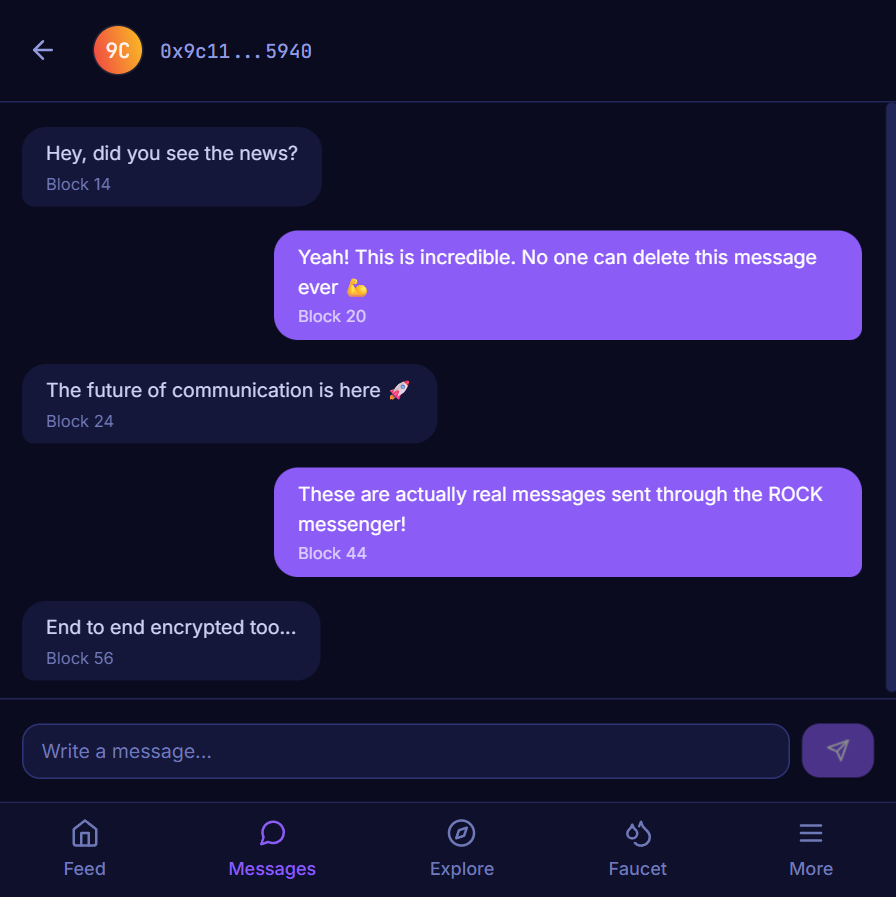
Rock is the first messenger to ride directly on a Layer 1 that separates transaction blocks from message blocks. Chats, channels, and feeds are written into message blocks, which makes conversation history permanent, indexable, and nearly free.

Obsidian DBT² lets the chain process transaction blocks and message blocks in parallel, so Rock can deliver fast, encrypted, nearly free messaging while normal transactions remain unhindered.
At launch
v1 preview clients
Web messenger and prototype mobile shells focused on core messaging.
Message cost
Near zero gas
Message blocks are subsidized at the protocol level for validators and archive nodes.
Persistence
On chain by default
Chats, channels, and HTML cards are written into permanent message storage layers.
Rock v1 is an early test experience. Features, interfaces, and performance are subject to rapid iteration.
How Rock uses the chain
From your message box to the validator set

Every Rock message is quietly formatted as a tiny data blob and sent to an Obsidian node. Validators batch these blobs into message blocks that sit beside transaction blocks.

  • Rock clients wrap chats as text, JSON, or encrypted bytes.
  • Execution clients validate size and structure before queuing.
  • Consensus chooses a validator that proposes a new message block.
  • Once finalized, indexers scan the block so Rock can rebuild full chat history instantly.
What Rock v1 includes
Enough to prove the model, not yet a full super app

The v1 preview is focused on core flows that prove the dual block design in the real world.

  • End to end encrypted one to one chats using chain backed identity.
  • Small private groups and invite links that sit on chain.
  • Public broadcast channels suitable for announcements and feeds.
  • Simple on chain handles so contacts can move across devices without central accounts.
Why it is different
Messaging runs at the protocol level instead of on top

Traditional apps keep conversations in proprietary databases. Rock speaks directly to a chain built for communication.

  • Dedicated message blocks for chat data, not just financial transactions.
  • Near zero gas data blobs that keep per message cost negligible.
  • Archive nodes rewarded to store complete history so messages survive devices and companies.
  • Custom indexers designed for fast retrieval, search, and feed building.
Where Rock is headed
From messaging client to full communication layer

The client you see in v1 is only the first interface on a new communication primitive.

  • Richer channels for communities, creators, and enterprise notification rails.
  • On chain documents and HTML cards that render directly inside chats.
  • Developer hooks so any app can reuse Rock transport for in app messaging.
  • Multi client ecosystem where different frontends share the same message layer.
Try Rock live inside this page

This is the live Rock test client running on the Obsidian testnet. You can click or tap inside the phone, open chats, and send test messages. Everything you do here is written into Obsidian message blocks.

Live alpha preview · Obsidian testnet

How to interact
Tap anywhere inside the phone frame to use Rock. Move between screens, open threads, and send test messages just like you would in a normal messaging app.

Fully interactive test client. No install needed so visitors and investors can feel how dual block messaging works in practice.
For token holders · Why this matters

DBT² turns communication into an on chain asset class

Obsidian separates value transactions from messages at the protocol level. Two sequential block streams share one consensus and one token, so the network can scale communication without blowing up fees for transactions.

Technological breakthrough
Most chains push value transactions and messages into the same sequential block stream. DBT² gives each its own dedicated stream in the schedule under a single validator set and consensus.
What this unlocks
Real time encrypted chat, feeds, logs, and machine data can grow on chain while settlement for payments and DeFi stays predictable and easier to model.
Why it matters for OBS
DBT² lets the chain schedule transactions and communication on separate streams that share one token. Messaging can approach near zero cost at the app level while still driving validator rewards, network usage, and long term demand for OBS.
2
Dedicated block types
1
Token and security model
Message scale potential
DBT² schedule and block types
  • Transaction blocks behave like familiar EVM blocks and execute state changing transactions for payments, DeFi, and contracts.
  • Message blocks appear at defined points in the same chain and carry capped size data blobs that do not mutate global state.
  • Both block types are finalized in the same canonical history, so explorers and apps see one chain with two roles instead of two disconnected networks.
Why this is superior to single stream chains
  • On single stream chains, messages and heavy data compete with value transactions for the same block space, so social traffic can push up fees for everything else.
  • On Obsidian, communication lives in message blocks, so surges in chat or content do not crowd out value flow or make settlement harder to price.
  • This separation lets the network serve social scale workloads and financial workloads at the same time instead of forcing one to compromise the other.
Nodes, history, and incentives
  • Full nodes validate both transaction and message blocks and keep recent history light enough for regular participants.
  • Archive nodes store full transaction and message content so chats, posts, and data feeds remain addressable over time.
  • OBS powers staking, gas on transaction blocks, validator rewards, message block rewards, and archival incentives, so more on chain communication naturally routes through one asset.
Communication stops competing with capital for block space. That is why DBT² is a proprietary, defensible design for long horizon token holders.
Single stream chains
One shared lane
$ 💬 $ 💬 $
Fees and congestion from transactions and messages stack into the same sequence of blocks.
Obsidian DBT²
$
Value stream
Payments and DeFi
$ $ $ $
💬
Message stream
Chat, feeds, logs, machine data
💬 💬 💬 💬
Obsidian Chain · OBS Token Role

How a communication first Layer 1 creates structural demand for OBS

Obsidian runs a single sequential chain with Dual Block Technology (DBT²). Transaction blocks update state and carry value and contracts. Message blocks carry low cost data such as chat, content, and JSON. Both block types share one validator set and one token, so OBS backs security, execution, and long term participation across the network.

A new category of Layer 1

Most chains are built around value transfer. Obsidian is built around communication, with message blocks that carry chat, HTML, JSON, and app data without touching global state or congesting transaction blocks in the same sequence.

  • High volume messages are scheduled as their own block type instead of competing for gas inside transaction blocks.
  • This opens use cases like on chain messaging, feeds, and documents that existing single block designs handle poorly.

Incentives wired for throughput

Validators and archive nodes are rewarded for keeping both transaction and message blocks moving in the shared schedule. To take those roles, they stake the same asset that end users and builders hold, the OBS token.

  • Growth in messaging and data increases demand for well staked validators and deep storage capacity.
  • Over time, more supply sits with participants who are actively securing and operating the chain.

Applications converge on one asset

Messaging is designed to be priced near zero at the app level, while OBS still pays for gas, smart contracts, bridges, and higher priority access. Both the communication layer and the financial layer settle on the same token.

  • Developers can build chat, social, and data rich apps without inventing separate incentive tokens.
  • This keeps economic gravity centered on OBS as the coordination asset for the ecosystem.
How communication drives the network and the token
Step 1
High volume messaging
Users, apps, and machines push chat, content, and data through dedicated message blocks in the same sequential chain, without congesting transaction blocks.
Step 2
More nodes and stake
Validators and archive nodes scale up to handle the load, each one operating with OBS staked to secure consensus and store history for both block types.
Step 3
Richer on chain data layer
Indexers and applications plug into a permanent record of messages and state, using OBS for computation, access, and higher priority throughput.
Step 4
Stronger role in the ecosystem
As more communication and apps sit on Obsidian, the chain becomes core infrastructure, and OBS is the asset that aligns everyone who runs, builds on, and uses it.

Taken together, dual block technology on a single sequential chain, message first design, and staking based incentives create a network where communication, storage, and computation all connect through the OBS token. The next section walks through the supply schedule and reward structure that support this model from genesis onward.

Obsidian Chain · Token Economics

Supply, token sales, and rewards at a glance

A fixed 200,000,000 OBS genesis supply, three sale rounds, and a simple reward schedule that starts at zero net inflation then tapers into a low single digit range as the network matures.

Total supply
200,000,000 OBS
Fixed at genesis
Public and presale
25% · 50,000,000 OBS
Three rounds at $0.50, $1.00, and $1.25 per OBS equivalent
Reward schedule
0% → ≈1–3%
Years 1–2 net 0% (mint and burn matched), then about 1–3% yearly inflation

Obsidian token distribution

Supply is split between public participants, the Obsidian Foundation, long term contributors, and a reward engine that combines the best of Ethereum and Solana: zero net inflation in the first years, then a small, predictable inflation band.

Founders and team Four to six year vesting with a one year cliff across the team and founder pool to keep incentives aligned with long term network growth.
Foundation, validators, and nodes The Obsidian Foundation manages treasury, validator delegations, archive node incentives, and the mint burn schedule that keeps net inflation at 0% in years 1 and 2, then in a low 1–3% range after.
Three sale rounds Ten percent of supply at $0.50, ten percent at $1.00, and five percent at $1.25 before mainnet, giving the best entry to the earliest participants.
Obsidian Chain · Validator Rewards & Inflation

Zero net inflation in years 1–2, controlled growth after

Genesis supply starts at 200,000,000 OBS. For the first two full years, minted validator rewards are fully offset by burns, keeping net supply flat before easing into a low single digit inflation range as the network matures.

Genesis supply
200,000,000 OBS
Fixed at launch
Net inflation · Years 1–2
0%
Minted rewards fully offset by burns
Estimated inflation after year 2
≈1–3% per year
Gradual step down as validator rewards taper into a low single digit range

How the schedule works

The protocol mints new OBS to pay validators for securing both transaction blocks and message blocks. In years one and two, the Obsidian Foundation commits to burning the same number of tokens that are minted for rewards.

That keeps total supply pinned at 200,000,000 OBS while the validator set grows and the network hardens. Holders avoid early inflation, while validators still get paid.

From year three onward, net supply increases slowly in a low single digit range, with annual minting stepping down from about 3% of genesis supply toward roughly 1% over the first six years. The chart shows yearly minting, burns, and the total OBS supply line staying close to the 200,000,000 baseline and trending toward about 218–220 million OBS over that period.

In practice this blends Ethereum style dynamic issuance with a Solana style declining inflation curve, plus Obsidian's two year zero net inflation phase.

Years 1–2 Mint 8M OBS per year and burn 8M per year. Net supply change: 0M (0%).
Years 3–6 Mint 6M, 5M, 4M, then 3M OBS per year with no burns, creating a slow, predictable net increase in roughly the 1–3% range while the network reaches a steady state.

What this means for tokenholders

Early tokenholders get the benefit of validator secured block production without being diluted by high inflation. In the first two years, net supply does not increase, so any price appreciation is driven by adoption and demand, not token emissions.

After year two, inflation remains in a controlled low single digit range, funding validator and archive node rewards while keeping dilution tightly bounded. The total projected increase over the first six years is roughly 10% versus genesis supply.

The result is a reward engine that behaves much closer to a capped asset than a high inflation rewards token, while still paying validators enough to keep the network secure.

OBS Token Sale Preview
Access OBS ahead of mainnet launch
OBS Native network token Planned sale allocation: 50,000,000 OBS (25 percent of supply)
Token sale is not live. Everything on this page is preliminary and for discussion only, not an offer or solicitation.
Planned round structure
You are here · Round 1 (planning) Sale is not yet open. Terms and eligibility may change before launch.
Round 1 · Early access
$0.50
Allocation: 20,000,000 OBS Share of supply: 10 percent
Earliest entry level and largest price step to the illustrative launch reference.
Next planned
Round 2 · Scaling
$1.00
Allocation: 20,000,000 OBS Share of supply: 10 percent
Second price level as the network and community expand before mainnet launch.
Final planned
Round 3 · Pre launch
$1.25
Allocation: 10,000,000 OBS Share of supply: 5 percent
Final round aligned with the illustrative 1.25 launch reference. Limited size before mainnet.
Total planned sale 50,000,000 OBS Equal to 25 percent of the fixed 200,000,000 OBS genesis supply across three rounds.
Unfilled allocations Return to treasury Any unsold tokens in a round are expected to stay with the Foundation or treasury for future ecosystem use, not reminted or double counted.
Sale status
Preview only
All figures and rounds shown are indicative. Final terms, eligibility, and documentation will be provided separately if Obsidian proceeds with a token sale.
Genesis supply
200,000,000 OBS
Token sale allocations are carved from a fixed genesis supply. No additional OBS is created for this program beyond the planned 50,000,000 OBS sale allocation.

Structure and mechanics overview

Token representation

During the sale, participants would receive wOBS, a token on the Ethereum network intended to represent future native OBS one to one.

At Obsidian mainnet launch, holders of wOBS are expected to redeem for native OBS by connecting the same Ethereum address, subject to final bridge, timing, and redemption mechanics.

Supply alignment

The planned sale allocation of 50,000,000 OBS comes from the fixed 200,000,000 OBS genesis supply across three rounds at 0.50, 1.00, and 1.25.

Any unsold amount remains under Foundation or treasury control for future ecosystem, liquidity, or strategic programs. It is not reminted or double counted.

Eligibility and compliance

Any future sale would be conducted in line with applicable laws and may be limited to qualified or eligible participants depending on jurisdiction.

Detailed terms, risk disclosures, and offering documents would need to be reviewed and accepted before any participation. Nothing here should be treated as legal, tax, or investment advice.

This section is for informational purposes only. It is not a commitment to proceed with a token sale and does not constitute an offer to sell or a solicitation to buy any securities or tokens in any jurisdiction.

Sale process preview

Illustrative participation flow

If a token sale is launched, qualified participants would use a standard Ethereum wallet with a simple on chain flow.

  1. Connect an Ethereum wallet. For example, MetaMask or another browser wallet on Ethereum mainnet.
  2. Fund with ETH or a supported stablecoin. Ensure balance covers the intended OBS purchase and network fees.
  3. Open the verified sale link. The interface routes to the official wOBS pair for the active round, once and if it goes live.
  4. Set the purchase amount. Swap into wOBS at the current round price, subject to the cap for that round and the total sale program.
  5. Hold wOBS until mainnet. At Obsidian launch, redeem wOBS one to one for native OBS from the same address, subject to final terms.

Round 1: $0.50 · 20,000,000 OBS (10 percent of supply)
Round 2: $1.00 · 20,000,000 OBS (10 percent of supply)
Round 3: $1.25 · 10,000,000 OBS (5 percent of supply)
Total sale cap: 50,000,000 OBS from a fixed 200,000,000 OBS genesis supply
Status: Sale not live and all figures are subject to change.

Sale interface preview Wallet connection and swap link
Wallet connection is available in preview mode. No swaps are active and no OBS can be purchased at this time.
Planned round pricing
Round 1$0.50 · 20,000,000 OBS
Round 2$1.00 · 20,000,000 OBS
Round 3$1.25 · 10,000,000 OBS
Sale Not Live

Once and if a sale opens, this button routes to the official wOBS pair on Ethereum for the active round. Always confirm the contract address and network in your wallet before interacting with any token.

Project updates

Get notified when rounds and launches go live

Join the Obsidian update list for emails when token rounds open, launch dates are announced, and major releases go live.

Stay on the update list
Enter your email to receive important project updates.

You will receive occasional emails about token rounds, launch timing, and major Obsidian news. You can unsubscribe once the email system is online.

Planned use of presale proceeds

How presale funds are expected to grow the Obsidian ecosystem

If a presale is completed, Obsidian Chain Corporation would receive the proceeds and allocate them to Obsidian Labs Corporation under a formal development arrangement. Labs is responsible for shipping product, securing exchange relationships, operating core infrastructure, and growing the ecosystem over time.

Obsidian Chain Corporation
Issues tokens, receives presale proceeds, and enters into development agreements.
Development funding
Budgeted and transferred to Labs under documented arrangements
Obsidian Labs Corporation
Uses funds to build applications, validators, bridges, exchanges, and data infrastructure that support the chain and its users.

Centralized exchange listing

Priority funding to pursue listing on a major centralized exchange, such as Coinbase or an equivalent venue, subject to their review and approval.

  • Preparation, due diligence support, technical integration, and compliance work streams.
  • Liquidity, market making, and relationships that support healthy order books and price discovery.
  • Intended to make OBS easier to access for global users, funds, and institutional participants.

ROCK encrypted messenger

Continued development of the ROCK messaging application so everyday communication drives on chain activity on Obsidian.

  • Product polish for mobile and desktop clients, encryption hardening, and reliability improvements.
  • Scaling work to support high volume messaging, group features, and richer media.

Native DEX and cross chain bridge

Building an Obsidian based decentralized exchange and secure cross chain bridges that connect liquidity with other networks.

  • Targeting a production DEX release following mainnet launch, subject to development progress and security reviews.
  • Bridge infrastructure connecting Ethereum and Obsidian for OBS and wrapped assets.

Validator network and staking tooling

Expanding and hardening the validator network so token holders can participate in securing the chain through delegation.

  • Infrastructure, documentation, and onboarding flows for professional and community validators.
  • Staking interfaces that allow holders to delegate and track protocol rewards securely.

Archive nodes and indexers

Investment in archive nodes and indexing infrastructure to make on chain messages, content, and data fast to query at scale.

  • Archive node deployments and incentive programs that preserve full history of message and transaction data.
  • Indexing services, APIs, and developer tools that power explorers, analytics, and third party applications.

Security, audits, and compliance

Ongoing security work for the protocol, applications, and infrastructure, along with legal and compliance support where needed.

  • External code audits, penetration testing, and monitoring for core contracts and infrastructure.
  • Legal, accounting, and compliance work intended to support responsible operation of the ecosystem.

Strategic marketing and partnerships

Programs designed to bring attention, adoption, and high quality partners into the network.

  • Targeted campaigns, events, and content with creators, communities, and technical partners.
  • Selective partnerships with teams, wallets, and platforms that add users, liquidity, and real usage.

Operational runway and reserves

Maintaining a reasonable operating runway so Labs can continue development, support, and ecosystem work through market cycles.

  • Core team, infrastructure, and support costs aligned with multi year delivery of the roadmap.
  • Flexibility to direct capital to the areas that most improve network health and long term adoption.

This overview is forward looking and may change as conditions and priorities evolve. It is provided for informational purposes only and is not an offer to sell or a solicitation to buy securities or tokens.

Obsidian Chain · Roadmap

From prototype and presale to mainnet scale

The chain and ROCK messenger are already running in a prototype environment. The roadmap below outlines a target sequence for presale rounds, mainnet launch, validator growth, and major protocol upgrades. All milestones and dates are forward looking estimates and may change.

Obsidian node
Now

Prototype chain and ROCK live in testing

• Core chain running in a controlled prototype environment.
• ROCK messenger and block explorer live for internal and limited external testing.
• Validator and archive node roles exercised for performance and reliability tuning.

Obsidian node
Q4 2025

Public testnet and developer access

• Public messaging and content testnet opened for early users and builders.
• ROCK test builds available to demonstrate near zero cost messaging on DBT².
• Explorer, basic documentation, and example apps available for developers.

Obsidian node
January 1, 2026

OBS presale Round 1 opens

• Target opening date for OBS presale Round 1 via wOBS on Ethereum, as part of the 20,000,000 OBS presale pool.
• Focus on strategic participants and early community members aligned with long term validator and ecosystem growth.
• Funds received by Obsidian Chain Corporation and deployed to Obsidian Labs under a development agreement.

Obsidian node
Q2 2026

OBS presale Round 2 and mainnet window

• Second presale allocation offered from the remaining OBS presale pool.
• Broader community and ecosystem partners onboarded with clear token allocation and vesting disclosures.
• Target announcement of the mainnet genesis window and validator onboarding plan.

Obsidian node
Q3 2026

Final presale allocations and validator dry runs

• Final presale round, closing out the planned OBS presale allocation before mainnet.
• Early validator, archive node, and infrastructure partners complete mainnet style rehearsals.
• Public release of mainnet configuration, economic schedule, and initial validator requirements.

Obsidian node
Q4 2026

Mainnet genesis, ROCK v1, bridge, and DEX

• Target mainnet genesis in line with the published 200,000,000 OBS schedule.
• Initial validator set live with staking enabled for token holders through delegation.
• ROCK messenger production release connected to mainnet, Obsidian bridge v1 for wOBS redemption, and native DEX v1 for OBS and core pairs.
• Obsidian Chain Corporation intends to offset year one validator rewards with an annual burn targeting near zero net supply change.

Obsidian node
2027

Silicon Fork upgrade and exchange growth

• Silicon Fork protocol upgrade targeted to improve latency, messaging throughput, and validator efficiency.
• Ongoing pursuit of centralized exchange listings and deeper liquidity on the native DEX, subject to market and regulatory conditions.
• Expanded delegated staking features and tooling for validators, indexers, and infrastructure partners.

Obsidian node
Late 2027

Archive node expansion and second annual burn

• Archive node incentives and infrastructure expanded for faster historical search and long term scaling of on chain content.
• Second annual burn intended to match validator rewards for the second full year, keeping years one and two net supply near flat.
• Network targets multi year uptime with a geographically distributed validator and archive node set.

Obsidian node
2028 and beyond

Low inflation era and ecosystem scale

• Transition into a controlled low single digit inflation band to support long term validator, archive node, and ecosystem rewards.
• Enterprise messaging, audit trails, and data tooling expanded on chain using DBT² messaging and content features.
• Ongoing CEX, DEX, and validator relationships deepen liquidity, resilience, and real world usage of the network.

This roadmap is illustrative and for information only. Milestones, order of events, and timing are goals based on current plans and are not promises or guarantees.

Obsidian Chain · FAQ

Frequently asked questions

Clear, straightforward answers about the chain, the OBS token, ROCK messenger, validators, and how the overall model fits together.

Obsidian Chain is a Layer 1 blockchain that treats communication as a primary use case, not an afterthought. It runs a single sequential chain with two block types under one validator set. Transaction blocks handle value and smart contracts. Message blocks carry chats, posts, documents, and data so high volume communication does not crowd out normal transactions.
Dual Block Technology (DBT²) means the protocol defines two block streams that share one timeline and one history. Every block is part of a single sequential chain, but a block is classified as either a transaction block or a message block. Validators secure both types, and applications can rely on the same consensus while treating value flow and communication as separate lanes at the protocol level.
Most chains price every interaction like a financial transaction, which makes social feeds, messaging, and data logs expensive or impractical. Obsidian gives communication its own lane with a different cost profile, so chats, posts, machine data, and app messages can scale toward near zero cost while settlement and DeFi stay predictable.
ROCK is an encrypted messenger built by Obsidian Labs that runs directly on message blocks. It uses the chain for ordering, delivery, and storage of chats and channels, while encryption happens at the application level. ROCK is a live reference app that demonstrates near zero cost messaging on mainnet and shows social platforms what is possible on Obsidian.
OBS is the native asset of Obsidian Chain. It is used to secure validators, reward archive nodes, pay gas on transaction blocks, pay fees on message blocks, and coordinate future governance functions as they come online. As more communication and applications move on chain, OBS becomes the asset that ties together security, storage, and access.
Genesis supply is fixed at 200,000,000 OBS. That supply is allocated across a presale pool, founders with vesting, Obsidian Chain Corporation treasury, Obsidian Labs development pool, community and ecosystem programs, liquidity, and strategic reserves. Allocation percentages, vesting terms, and dedicated pools for validators, archive nodes, and builders are described in the tokenomics section of this site.
The protocol mints OBS to pay validators and long term infrastructure, but Obsidian Chain Corporation plans to match those early emissions with burns. In years one and two the goal is zero net inflation, with minted rewards offset by corporate burns so total supply stays near 200,000,000 OBS. After that, net issuance moves into a low single digit range to fund ongoing validator and archive incentives while keeping dilution tightly controlled.
The network is designed so that validators and supporting infrastructure can be run by independent operators who stake OBS. Over time, tokenholders who do not run their own validators may be able to delegate or participate through pools, subject to local regulations and the final staking model. Details on validator requirements, yields, and delegation options will be documented as mainnet and the validator program roll out.
Obsidian Chain Corporation is responsible for the network and token layer. It stewards the genesis supply, manages reserve allocations, and oversees the long term issuance schedule for validators and archive nodes. Obsidian Labs is an independent development company that built the architecture, maintains ROCK, and plans to deliver the DEX, bridge, and other applications, but does not control token issuance.
The primary asset is native OBS on Obsidian Chain. For onboarding and liquidity, Obsidian may use a representation of OBS on Ethereum that functions as a claim on native tokens at mainnet launch. Any such representation is intended as a technical bridge rather than a separate long term asset, and final terms will be published in dedicated documentation before any presale opens.
Obsidian Labs intends to pursue listings with one or more major centralized exchanges and to deploy a native decentralized exchange and bridge on Obsidian Chain. These efforts are a priority because they improve access, deepen liquidity, and support a healthier market for OBS. Timelines, partners, and listing outcomes depend on third party decisions and market conditions, so no specific listing or date can be guaranteed.
The chain is already running in a working environment with ROCK and a block explorer in testing. Targets include a presale window around early 2026, mainnet genesis shortly after, ROCK on public app stores, a native DEX and bridge during 2026, and upgrades to archive nodes and protocol performance into 2027. All dates are goals that can move as audits, security reviews, and real world testing require.
At the protocol level, blocks and their contents are part of a permanent ledger and are replicated across the network. Privacy for users comes from encryption and application design, not from hiding the existence of messages on the chain. ROCK and other apps are built to encrypt content so it is readable only by intended parties while still benefiting from on chain ordering and history.
No. Information on this site is descriptive and for general informational purposes only. Obsidian Chain Corporation does not use this site to make a public offering of securities or to solicit investment from the general public. Any future token sales or equity discussions would be conducted in a manner intended to align with applicable regulations in relevant jurisdictions, and anyone considering participation should consult independent legal and tax advisors.

Encrypted data transfer and messenger, powered by Block Chain technology.

Development

Bridge

DEX

© 2025 created by the Obsidian Labs Corporation