
The blockchain for public data.
Obsidian lets Web3 apps publish posts, receipts, documents, messages, and records without relying on centralized infrastructure.
Verifiable. Wallet-native. Accessible.
- Lane
- 07
- Block
- 179,459
- Sender
- 0x1337…b33f
- Payload
- In master chief we trust
A wallet-native record. Compact commitment in the canonical block. Payload on the publication layer.
Web3 apps still depend on centralized infrastructure for posts, receipts, documents, messages, and records.
The wallet may be on-chain, but the public evidence around everyday actions often lives in company databases or temporary storage. That makes important application history harder to verify, harder to preserve, and harder for users to truly own.
Obsidian gives apps a native decentralized publication layer through Silica, so application data can become a verifiable public record by default.
A side-by-side look at the same actions
- Where a post livesInside one company's databaseWallet-native record on Silica
- Where a receipt livesA line in a private APIPublic receipt anyone can verify
- Cost to the userPer-action fees or platform lock-inNo per-action gas costs for users
- Who can take it downWhoever owns the serverPublished once, kept in the open
Public data for real application workflows.
Obsidian is for the records people and applications need to inspect, share, prove, or revisit later.
- Posts01
- App receipts02
- Document transfers03
- Bills of sale04
- AI agent actions05
- Game events06
- Creator records07
- Audit logs08
Execution for contracts. Publication for data.
Obsidian keeps Ethereum compatibility while giving application data its own protocol path. Smart contracts remain available for logic, assets, and coordination. Silica handles the public data layer for records that should be published and verified.
EVM-compatible chain
Familiar Ethereum tooling. Familiar wallets. Contracts deploy without changes, so builders meet users where they already are.
Silica publication layer
A native decentralized publication layer for verifiable records, public receipts, messages, and documents.
Parallel data path
Payloads move through publication lanes while compact commitments are included in canonical blocks.
Less execution overhead
Apps avoid forcing every payload through smart contract execution, so users do not need to approve gas for each action.
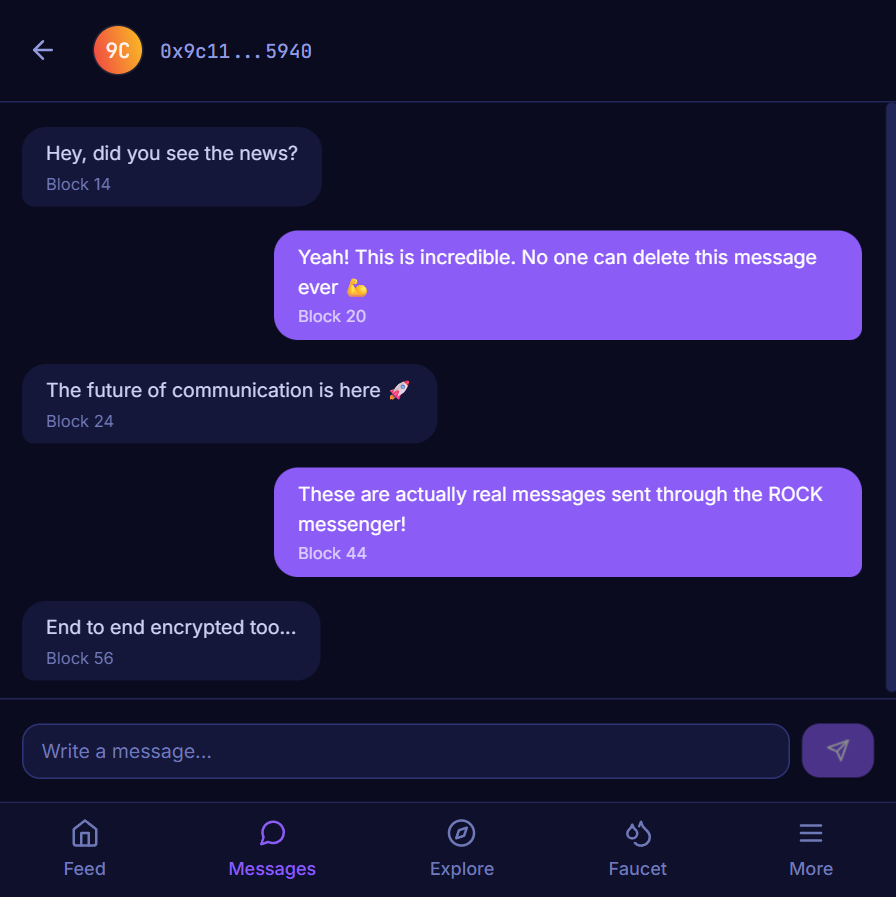
Built on Obsidian's publication layer.
Rock Messenger shows how Obsidian turns communication into wallet-native records. The publication layer carries the messages and the shared history while the product stays simple for everyday users.
Build apps that publish verifiable records by default.
The whitepaper
The architecture, the publication layer, and the design choices behind Obsidian.
Open the whitepaper→The technology
How Silica publishes data, how lanes work, and how commitments anchor to blocks.
Explore technology→Rock Messenger
An application built on Obsidian's publication layer for everyday communication.
Try Rock Messenger→Get notified when rounds and launches go live.
Join the Obsidian update list for emails when token rounds open, launch dates are announced, and major releases go live.